

Feeding the birds..
I just this week went out and bought a supply of bird seed having run out some time ago. The garden is now awash with blue, great and coal tits, nuthatches, house sparrows, a spotted woodpecker if it’s cold and one jackdaw, oh and the pheasants and partridge cleaning up after everyone. Every time I top up on bird feed I wonder if I'm really doing the right thing. If I’m being really honest with myself, I know that I’m feeding the birds for my own enjoyment of seeing them and the life they fill the garden with, and although I hope that in feeding the birds that visit the feeders I am making their lives a little easier, this is contrasted by the knowledge that I am probably upsetting the natural order of things.
Wild birds eat different things according to their species and the food that we supply in our garden bird feeders favours only some of our wild birds. I can’t help noticing also that almost all of the seeds and nuts supplied in bought bird food are non-native, which acts as another clue for me that we are disturbing the natural balance as the nutrient values of these foods are different from wild food. Studies on blue tits by the British Trust for Ornithology (BTO) show there is evidence to suggest that the higher fat content of garden bird food from feeders creates weaker offspring with a lower fledgling success rate.
Another perhaps more important reason that supplementary feeding of wild birds could be problematic is that it creates an imbalance in competition. Blue tits and great tits for example, are dominant species, often winning fights for the available food on feeders that they are adept at using, this advantage will impact on subordinate species whose numbers are in decline such as willow and marsh tits, that a 2021 study in Biology Conservation, has shown lose nearly half of their nesting sites to blue tits. Also our many migrating birds that come back in spring suffer this same disadvantage. To add to this the spread of many disease epidemics among birds that visit our gardens are attributed to garden feeders.
If I look around my local area there is a good chance that in this rural Wiltshire location, the birds have a lot of ‘natural’ food in ready supply.
In my garden, taking my cue from the natural surroundings, I am trying to grow more of the natural food of wild birds, leaving the seed heads or buds for the birds to enjoy. I notice that goldfinches are particularly attracted to the seed heads of marsh thistle and that blue tits happily munch on hazel buds. I leave ivy unclipped to supply nutritious berries with a good supply of fat. The author in the above report suggests ‘wildlife gardening as an alternative to feeders - that is, leaving part of our gardens wild or planting native trees and seasonal fruits, seeds and berries’. These, he said, ‘would be more likely to encourage natural feeding and with a wider variety of foods for different species’. Leaving the seedheads of plants such as lesser knapweed, teasels, purple loosestrife, yarrow and meadowsweet, to mention just a few, that look great in the garden would be an easy win in helping to supply wild birds with some supplementary natural food at the times they most need it whilst also fulfilling our desire to see birds in our gardens.
We may well consider supplementary feeding during the coldest periods of winter, when calories are much needed, and at the height of the nesting season when birds are expending a lot of energy gathering insects to feed their young.
My gut feeling though, about anything where we are ‘helping’ nature, is to stay as close to the root, if you forgive the pun, of the original natural system as we can.
Photo by Lidia Stawinska

Wild Seed for native plant sanctuary
One of the ways to grow wildflowers in your garden is to collect local seed. I’ve already started in August as plants set seed but this will carry on through to winter.
Not only are fairly common wildflowers put under stress by our use of the land in Britain for farming, housing, roads and industry, but also, are many of the more unusual plants, some of which that I’m trying to propagate for my garden, such as: greater celandine; woolly thistle; bird vetch; gromwell, woody nightshade, kidney vetch and vipers bugloss. All found either in the village where I live in Wiltshire or within a few miles.
Why would I want to grow these plants in my garden though? Aren’t they best left in the countryside? That depends on who is managing the countryside. I see time after time that rare and unusual wildflowers are not being given a chance to proliferate due to those responsible for the management of land following maintenance schedules that are in discord with the needs of the wild plant and the wildlife that it supports. This matters because these plants all play their own special part in holding the balance of the natural world.
This works by way of a fascinating tussle between plants protecting themselves against attack from insects by means of unpalatable chemicals or physical deterrents / barriers. It takes thousands of years for these relationships to develop, leaving most herbivorous insects with only one or very few plants, usually in the same family or even genus, that they can eat. It’s a very delicate situation, and an ill thought out mow or strim, not only removes the wild host plant for that year and lessens its chances of growing another, but more often than not causes fatal harm to an extraordinary and vulnerable insect. This also ripples up the food chain. For the 97% of terrestrial birds that feed their young on insects every year during nesting, this is a very big deal. Not to mention the small mammals, reptiles and amphibians that eat them also. The irony here being, if the countryside isn’t a safe place for nature then perhaps our gardens are.
If though, you are thinking of doing a similar thing, please recognise that there is a great responsibility in gathering seeds from the wild and it is to be kept to the absolute minimum. There is a very fine balance to be made between gathering a small amount of seed to build up a ‘support bank’ of wild plants in our gardens and reducing wild plants' stock’s ability to reproduce. I would urge anybody to seek out specimens in local gardens to share seeds or cuttings before seed collecting from plants in the wild.
As far as the law is concerned don’t dig up a plant in the wild at all, only take part of the plant (pick flowers, collect seed or take cuttings) if you know that they are not in a SSSI; another protected site, on the Schedule 8 list of the Countryside Act 1981 or on the Red Data List. So express caution and restraint if in doubt.
Wild plants - best practice
Beyond the law there are some really sensible guidelines that in forager lore are taken as good rules of thumb to abide by.
Never harvest endangered, rare or threatened species
Never take plant material from a SSSI, nature reserve or other protected site
Take no more than 5% or one twentieth of the plant / seed, and or only from a plant in amongst a minimum of 20 plants / large patches of plants
For identification purposes take photographs rather than samples
Be careful not to damage other vegetation when gathering material
Take only the minimum amount required and must not be used for commercial gain
Always know the name and understand the characteristics of the plant that you are harvesting from.
See the Botanical Society of Britain & Ireland (BSBI) Code of Conduct for good guidance.

Brimstone & Buckthorn
A couple of months ago I spotted a brimstone butterfly (gonepteryx rhamni). With its light yellow open wings, it is rumoured to be the origin of the word butterfly ‘butter coloured fly’. The one that visited us is likely to be the female being pale green.
On reading about it I found out that its larvae (caterpillars) eat only common buckthorn (Rhamnus cathartica) and alder buckthorn (Frangula alnus) so where are they? Of course the butterfly could have just been passing through. I’ve not seen these plants locally but would love to know if anyone knows of any in the area?
Both of these plants look pretty similar to dogwood (Cornus alba). Common buckthorn are not a particularly showy shrub / small tree that has black berries on about now. Alder buckthorn grow slightly larger to about 6m and have smaller berries that start off white / green, then red and mature to dark purple / black.
The adult brimstone butterfly is attracted to purple nectar food sources and after building up its resources on plants such as thistle, selfheal, knapweed, scabious and wild marjoram will prepare for winter hibernation amongst thickets of ivy and bramble, so I’ll be mindful of this when gardening over winter.
Ivy’s a good one to mention actually, it has two distinct phases of growth. Its first phase is known as juvenile and this is when the characteristic lobed leaves and climbing habit occur. Left a little longer, however, and the plant matures into its adult form that takes on a shruby nature, is non-climbing and has oval leaves. Only when adult does ivy flower and fruit. The small yellow / green flowers are pretty insignificant looking and appear in dome shaped clusters, but don’t underestimate the value of these as a great late food source for pollinating insects from September to November with bees, hoverflies, wasps and late flying butterflies buzzing and fluttering all over it.
In November as it transitions from flower to berry and on into December and January it supplies valuable fat rich food for birds such as thrushes and blackbirds, the more mature the ivy the more flowers and berries it will supply! Not to mention the habitat that it provides for bats, overwintering insects, birds and small mammals.
We have two native ivy’s, common ivy (Hedera helix) which is widespread across the UK and Atlantic ivy (Hedera hibernica) that is found more on the west coast of Britain and in Ireland. They’re pretty hard to tell apart especially as there is a lot of hybridisation between ivy’s but common ivy generally has 3 to 5 lobed leaves and Atlantic ivy 5 to 7.
So if you have a nice mature flowering and fruiting ivy that needs a trim, it might be a good idea for this butterfly and other wildlife to wait until spring and watch out for a brimstone in February / March as they are often one of the earliest to take flight after hibernation.
Photo by David Duarte Crespo

Bramble - Rubus fruticosus agg
Ouch!! I hear myself say as once again a bramble attacks me or defends itself, the same thing I guess. I literally keep a needle on my bedside table to pick out those little tips of bramble thorn that impale themselves into my hand, persisting in reddening and irritating more until I dig them out. How can something so small hurt so much?
The bramble is, in my mind, one of the few wild plants that is untameable, truly wild. Its nature unboundable in any horticultural sense.
For so much of the year it is a weed in the garden or a hindrance to country walks, taking as its own, field gates and styles, an absolute pain in the...ars…neck. Until, that is, the latter end of summer and in autumn, then it takes on a whole new persona, the sweet, delicious, finger staining delight of the blackberry.
Its wild nature doesn’t stop there though. We all know what a blackberry is right! But ask a botanist and watch them go pale as they hope they are not going to have to describe what taxonomic classification it fits into. For what is just a bramble to you or me, is one of an untold number of subspecies of its overarching latin name Rubus fruticosus, or Rubus fruticosus agg (aggregate) to be more correct and to allow for a large amount of speculation on the subject. In John Wright’s The Forager’s Calendar, 350 or so ‘micro-species’ is the number aired and Richard Maybe in his Flora Britannica mentions 400 but these numbers are something of a finger held to the wind. Such is the ambiguity of this plant that if you were an expert in their study you would have your own ‘ology’ as a batologist. Worth remembering that one for a pub quiz question!
These different plants lead to many and varied fruits, some small and hard, others sour, still more large and succulent. If you find a good one remember it and keep it to yourself because all blackberries are not alike and you may not find another as good!
I shouldn’t really be writing about blackberries for the October edition of the News, however, as folk law has it that if you eat them after Michaelmas, the 29th September, the Devil is supposed to have spat on them. This event, we would be led to believe, occurred when Lucifer, after fighting with Archangel Michael, was somewhat peeved after landing on a blackberry bush. Another reason might be because Michaelmas was, in medieval times, a useful date to delineate the seasons, ending the harvest and preparing for the coming winter. But it is most likely because of the grey mold or bacteria that are more prevalent in this season and can turn the fruit sour.
If you find a nice juicy blackberry in October go ahead and eat it I say but watch out for those thorns!
Image by Eric Michelat from Pixabay

Where do all the insects go in winter?
Where do all the insects go in winter? I hear you never ask.
Which is just as well because I don’t have the answer! This is something that I’ve been thinking about more and more though, and as I watch the countryside, I hope that some of the secrets begin to unveil themselves so that I can manage my own garden in a way that’s as nature friendly as possible.
To answer this we need to know a little about insect life cycles. I don’t suppose that we’ve got time here to look at all 20,000 of our British insect species and the answer of course is, it depends on which insect.
Insects, being cold blooded, can't usually survive a British winter being exposed to the elements so employ various strategies to overwinter. If we were to look only at butterflies we’d start to get an idea of the picture.
There are only 59 resident or regular migrant butterflies to Britain and they go through 4 stages of life cycle - ovum (egg), larvae (caterpillar), pupa (christalis) and imago (butterfly).
The vast majority of plant eating insects are what’s called specialist feeders, this means that they have evolved alongside either one or very few specific plants and built up resistance to their defensive chemicals designed to be unpalatable to other insects. Adults are more often generalist feeders able to use the nectar of various plants which is basically sugary water. Butterflies are no different and eggs will be laid on or nearby the food plant of the caterpillar with the larvae going through several stages called instars, moulting its skin and emerging as a slightly, or towards the later instars, quite radically different looking caterpillar.
To make the original question slightly more tricky, Butterfly Conservation tell us that British butterflies, depending on the species, can overwinter as any one of their life cycle stages with 9 overwintering as eggs, 31 spending it as caterpillars, 11 as a chrysalis and the remaining as adults.
Caterpillars can wrap themselves with silk in grass sheaths, or leaves, bury themselves underground, or slow down their munching at the base of grass tussocks. A chrysalis might hang from a low branch or be buried in leaves and adults find shelter or leave the country.
Probably the four butterflies that I notice most are the meadow brown (Maniola jurtina) peacock (Aglais io), red admiral (Vanessa atalanta) and comma (Polygonia c-album).
Two of these species, the peacock and comma butterflies go into a state similar to hibernation as adults in sites such as on sheltered tree trunks, in hollow trees, woodpiles or the crevices of buildings. Probably our most common butterfly, the meadow brown overwinters as a caterpillar at the base of grasses and the red admiral generally and sensibly in my opinion, overwinters in the warmer climes of southern Europe and North Africa.
The peacock, red admiral and comma butterflies, by the way, all share hop (Humulus lupulus) or common nettle (Urtica dioica) as their sole food source. With the larvae food plant of the meadow brown as mentioned above being native grasses.
So how does this help me manage my garden? I guess it’s a balance, as least disturbance as possible protects overwintering insects, but a meadow for example, to invigorate the growth of plants pollinated by insects (nectar providing plants), disturbance, light and reduction of competition by the cutting of grasses is required. My personal preference is to leave mostly alone and seed native wild flowers outside of the majority of the grassland. Tidy to a level that is minimal but tolerable, and allow areas of untouched scrub, but each of us have our limits and if anyone comes to my garden they’ll know my limits are loose bordering on feral, much like myself.

Orchid spotting
Now is the time to go looking for wild orchids. In fact any time from May to September you may find an orchid flowering.
There are 57 species of orchid in the UK, most of which are pollinated by insects, but to confuse the issue of identification orchids can have immense variability even within species as they hybridise readily, with the resulting plant displaying different characteristics from the parent plants.
Considering some of their rarity, as a plant family orchids are incredibly successful, with somewhere in the region of 28,000 species, they make up nearly 10% of all plant species worldwide.
The seeds of orchids are tiny and do not store enough food to grow on their own, so they have symbiotic relationships with specific mycorrhizal fungi in the soil upon which the early stages of their growth are entirely dependent for all of their nutrients until they are able to grow leaves and photosynthesise, in turn supplying specific sugars called exudates to the fungi. Some orchids like the bird’s nest orchid (Neottia nidus-avis) with its caramel coloured flowers and no leaves or green chlorophyll are entirely dependent on soil fungi for their nutrition throughout their lifetime. These grow in shady beech woods and can be found on hazel coppice. Not that I’ve seen one yet, though I'm keeping my eyes peeled!
For this reason, buying a packet of orchid seeds and scattering them in your garden is unlikely to yield results, but by changing the cultivation of parts of the garden and leaving areas unmown for a while in the spring / summer you may be really lucky and have one or some pop up.
Grass verges, meadows and wood pastures are probably your best bet for spotting orchids, with the giveaway name of the common spotted orchid (Dactylorhiza fuchsii) being one of the most likely that you will see. The scented flowers of this orchid are pale pink with darker spots and stripes on their three lobed lips (lower decorative landing pad petal) and are highly attractive to day-flying moths.
That’s the tongue twister of the month sorted! - Three lobed lipped lower landing pad petals.
Another that you might see is the pyramidal orchid (Anacamptis pyramidalis), this is a slightly smaller, more densely packed flower, or inflorescence I should say as it contains about 100 individual deep pink / purple flowers.
I’ve been lucky enough to see both of these on my walks with Stevie and am keeping an eye out for other species too.
Do let me know if you’ve seen any or anything unusual in your garden or out and about!
It goes without saying that digging up any plant in the wild is illegal (without the landowners permission), this whole area of legislation is pretty complicated so you could find yourself on the wrong side of the law for picking flowers also, with the orchids its best to admire them and leave them be.
Image by Denise Wolters from Pixabay

Violet oil beetle
Having had reported to me a couple of sightings of the violet oil beetle (Meloe violaceus) in April and May respectively (which I am very jealous about!), one in a garden and one in a pasture field, I thought I’d share a bit on this little beauty as they’re interesting guys - and not so little actually as far as beetles are concerned with the larger female growing up to 3 cm in length.
In his book Bringing Nature Home, Doug Tallamy has some amazing facts about beetles, he tells us that if diversity is a measure, beetles are far and away the most successful multicellular organisms alive today. There are over 300,000 named species of beetle, with likely many more to be named yet. That's only a little less than the estimated 320,000 world's plant species. There are six times as many described beetles as there are all vertebrates combined, 34 times more than birds. Astonishingly 30% of all animals are beetles!
The violet oil beetle is one of only four left of the eight oil beetles native to Britain. The other four have gone extinct, probably due to the lack of wildflower rich, semi-natural grasslands which have been in serious decline since the 1950’s mostly because of the change in agricultural methods. Their diet being lesser celandine (Ranunculus ficaria) and soft grasses.
The rugged oil beetle is rare and the short-necked oil beetle is very rare, the violet and black oil beetle are the most locally common, that’s not to say nationally common, of which none of them are. In fact, according to Buglife, only three sightings of the violet oil beetle have been made in the east side of Britain since the 1960’s. They are only really to be found in the South West, and the Peak and Lake districts.
In spring, the larvae climb out of the hole that the female beetle burrowed in may/June the previous year to lay her eggs, these ‘triungulins’ hitch a ride on a solitary bee’s back to the bees nest in which they proceed to eat the eggs of the host bee, the larvae grow and then go through another stage eating the pollen meant for the bees young before pupating and emerging as an adult the next spring, she then mates digs a burrow to lay her eggs and the whole process starts again.
Because of this, the violet oil beetle is an indicator of a good local solitary bee population and of high quality wildflower rich grasslands.
The oil part of the name refers to a noxious substance released from their knees if disturbed, allowing them to travel above ground in view of insect eating birds and without fear of being eaten.
If you have been lucky enough to have made a sighting of an oil beetle or in fact any unusual insect or plant, you can do your part as a citizen scientist by submitting a record of it on iRecord.
And/or send me pics of anything unusual in your garden as I’d love to know!
Image by Rezső Terbe from Pixabay

White and yellow flowers
Spring is in full swing now, thank goodness. It felt like a long time coming this year.
Over the last couple of months around the village, looking at the hedgerows, field margins, road verges and wilder parts of our gardens you’ll probably have noticed some of the spring flowers brightening up our days.
Early on, we saw primrose Primula vulgaris and daffodil Narcissus pseudonarcissus, then lesser celandine Ficaria verna, wood anemone Anemone nemorosa and goat willow Salix caprea; a little later came greater stitchwort Stellaria holostea, dandelion Taraxacum officinale, gorse Ulex europaeus and broom Cytisus scoparius and into May, ramsons Allium ursinum and creeping buttercup Ranunculus repens to name a few.
The thing that these plants have in common, whether herbaceous, shrub or tree is that they all have yellow or white and yellow flowers. Most of these plants are woodland or woodland edge species and in order to reproduce through seed, need to flower and attract pollinators before the woodland canopy comes into leaf and shades them out.
Most of these plant species will have markings on their petals that cannot be seen with the human eye but can be detected by the highly specialised eyesight of pollinating insects. These markings direct insects to the nectar within the flower and ensure that pollen is collected in the process of feeding. Flowers will have different markings particular to their species to try to encourage the pollinating insect to visit many flowers of the same species and subsequently deposit the (male) pollen from the stamen onto the stigma (female part) of flowers in the process.
Reproduction is pretty complex with flowering plants, most plants are hermaphroditic having male and female parts in the same flower, and can reproduce with the male and female parts of the same flower; some, reproduce using separate male and female flowers on the same plant (monoecious - meaning ‘one house’) and other still, such as the goat willow above, reproduce by having one plant of the species with only male flowers, and another with only female flowers (dioecious), the pollinating insect must visit different sexed plants of the same species in order to reproduce. Holly Ilex aquifolium, is also dioecious and famously, will only have the berries on the female plants, so if you have a holly that doesn’t have berries in autumn / winter, this may be why.
The shape and structure of a flower also guides the appropriate insect towards it and this plays another part in attracting insects to the plant's flower, efficiency of reproduction is key and all of this needs communicating to the pollinating insect. For the spring flowers, their biggest issues are that the number of pollinating insects can be very low, as can the light levels compared with summer. Yellow has been shown to be a highly effective colour to stand out in these conditions and subsequently is a good strategy to attract insects towards them.
The process by which flowers grow, and know when to open their flowers is known as photoperiodism and as we get into May and light levels rise and lengthen many more plants are opening up their flowers and putting out their advertisements. Many of these will also have colours through the red and blue spectrum and may be showier to be attractive amongst increased competition. Most pollinating insects are known as generalists, which means that they don’t have a specialist relationship with one plant in particular and can feed from a variety of different plant flowers, though different pollinators are attracted to different colours and scent and adapted to flower shape. This month we will of course see the iconic bluebell in the woodland around, we’ll also see columbine Aquilegia vulgaris and comfrey Symphytum officinale to name a few. How hard they have to work for a living..
Image by Andreas Lischka from Pixabay

National Vegetation Classifications
I bent down to take a closer look at an insignificant looking little plant in a ditch the other day and noticed that, as with many of these plants, it was more impressive up close but also that on looking it up that it had a story to tell.
Recently, in wondering what to do about an alternative to the conundrum of species poor garden lawns, I’ve been reading a lot into grassland habitats and have stumbled across an Aladdin's cave of literature on our natural and semi-natural meadows and pastures. All have National Vegetation Classifications (NVC’s) and keys to their identification.
You’ll not be surprised to hear that it doesn’t stop there...
I understand that we can, by looking at the plants in our garden or the wider landscape, determine roughly what aspect it faces, whether it is wet or dry, or more acidic or alkaline on the pH scale. I also understand that, as mentioned in May 2022’s issue, certain plants such as wood anemone Anemone nemorosa can be indicators of, for example, ancient woodland.
On this theme I was looking up primrose Primula vulgaris as I hadn’t noticed it mentioned in the NVC grassland keys, it turns out on looking it up that the Dog’s mercury Mercurialis perennis (what a great name) that I’d bent down to inspect can be a key indicator plant of ancient woodlands, those being woodlands that have grown into a rich ecosystem and been present since at least 1600 CE, and along with this, every wild plant you can think of, each of them is an indicator of one or another ancient habitat and these become more specific as you add other plants into the mix.
According to the NVC field guide to woodlands, dog’s mercury might well lead one to investigate the surrounding area for ash Fraxinus excelsior and field maple Acer campestre as it is the distinctive field layer species, and if this were to have primrose and ground ivy Glechoma hederacea growing within it, for example, would fall into a subcategory of the above.
My little investigation was less of an in depth study than a curiosity, but it goes to show that the plant, the community of plants that it grows within and the region will all point towards a specific habitat. What’s more it also highlights the fragility of the landscape once conditions change due to occurrences such as a warming or cooling climate or something more direct such as an altering of the landscape mechanically or by way of additions such as fertilisers.
This one plant in a ditch next to a road on the edge of a field, may well be telling a story of once being part of the makeup of an ancient woodland and is along with many of its plant community a clue to a past landscape. But it also gives us the clue that if the land here were left to its own devices and given long enough, this is likely what it would become again.
Photo by Jack Blueberry on Unsplash

Deadwood
We are becoming quite used to terms to describe various habitats that benefit nature, often in relation to their decline, such as, woodland (especially ancient), woodland pasture, scrub, wetland etc. Less often talked about are the micro-habitats such as deadwood.
Often found as standing deadwood or fallen limbs, deadwood is not just a host to invertebrates such as the charismatic stag beetle Lucanus cervus, many fungi and lichen and also bryophytes such as mosses and liverworts; but also birds, bats and other mammals, reptiles, amphibians and, when in water, fish.
In a 2011 report by Buglife it was estimated that 13% of all species of plants and animals known in the UK are directly dependant on deadwood habitats while many more are dependant on saproxylic organisms themselves. A saproxylic species such as certain beetles (approximately 2000 in the uk) and fungi depend on dead or dying wood for at least part of their lifecycle. However, a report in 1989 (Speight) estimated that 40% of all saproxylic species were on the verge of extinction over much of their range, while the others were in decline.
Fungi are getting so much well deserved good press now as we learn more about mycorrhizae growing in association with plant roots and the mutualistic relationship that this fosters. They are also the primary agents of wood decay and, along with saproxylic insects, play a key role in nutrient cycling and ecosystem functioning, which is a fancy way to say that they make the natural world work a whole lot better: as wood decomposes, it returns important nutrients to the soil that in turn support new growth. It also supports as much as a fifth of all woodland species, many of which are considered rare or threatened such as the stag beetle mentioned above.
Where we have agency in our gardens or any other land that we may own or manage, and if it’s safe, we can leave deadwood where it stands. Maybe use it as a plant support or, when fallen, let it decompose naturally. Or if that’s a step too far down the eco warrior / tree hugger path, tidy it away into a corner somewhere but then leave it be. While all the good stuff that we can’t see is going on as it decomposes we might home a hedgehog, toad, frog or newt.
Standing and fallen deadwood, along with veteran trees, present by far the best insect hotel, bird feeder, bird box, bat box and bee box available and much more besides - and any that are safely left in the garden or countryside are offering untold benefits to our ecology.
I might start a new campaign, ‘keep Britain untidy’ but not litter. Don’t get me started…
Photo by Nick Smith https://nicksmithphotography.com

Tree shapes and oddities
Walking around the village in winter and seeing the deciduous trees bare of leaves and silhouetted against the sky, highlights some of the interesting tree shapes and oddities, making them appear more prominent.
There are several lime trees Tilia x europaea with excess growth, which looks like there’s a bush growing in the middle of the tree, with a flat bottom at just about maximum nibble height for deer and cows.
When you start looking, you see this a lot, mostly on limes but also on ash Fraxinus excelsior, especially since ash dieback disease (Hymenoscyphus fraxineus formerly known as Chalara fraxinea) entered the country in 2012 and subsequently found its feet.
This epicormic growth happens when trees of certain species put out extra growth from formerly dormant adventitious buds on their trunk or branches when under stress. Often because they have been pollarded (pruning to the top of the tree which promotes growth), but also because of other environmental damage such as drought or through having their bark chewed. This growth is often called water shoots and gardeners often know these from pruning their apple and pear trees.
Another feature that becomes more obvious when the landscape is less lush, are the lumps and bumps on the trunks of trees. These burrs, often found on oak Quercus robur trees, but also on other trees such as ash, beech Fagus sylvatica and walnut Juglans regia, are similar to the above stress shoots but the lumpy outgrowth is caused by the trees inner grain having developed in a deformed manner and enveloped small knots formed from dormant buds.
These burrs are highly valued in furniture making and for use in turning.
Lastly, from me anyway, are the ‘witches brooms’ that can be seen occasionally in a birch Betula pendula tree. From a distance they look like birds nests, but they are actually an infection of the tree’s buds or shoots associated with the parasitic fungus Taphrina betulina and causing localised growth, but they are not fully understood, much like witches, and could also be caused by other fungi, insects or viruses.
On that cheery note I’ll leave you!

British Native evergreen trees
December 2022
The conifer is synonymous with Christmas of course, though this is a relatively new tradition. In 1841 Queen Victoria’s new husband Albert introduced a German Christmas tradition into the British royal household. From that point on the Christmas tree has, apart from a small dip in popularity after the death of the Queen (Victoria), been on the up and up in this country, Western Europe, America and many other parts of the world.
The history of the Christmas tree’s origins are many and varied, but essentially evolve from the Pagan and Druidic celebrations of the Winter Solstice (21st December), this being the shortest day. The lack of daylight inspires the ‘celebrations of light’ with the encouragement of sunlight for the next half of the year and the hope for a fertile time to come.
To symbolise this a sprig of something green was brought into the home, which represented eternal life and the promise of replenishment during the winter months. Over the years this evolved into the tradition today of the evergreen tree.
The Christmas tree is also a Christian symbol and is said to have originated its religious roots through the English monk St Boniface who in the 7th century went to Germany to teach the word of God. Legend has it that he used the triangular shape of the Fir tree to describe the Holy Trinity.
The fir tree that we historically associate with Christmas is actually a Norway spruce Picea abies a native species of Germany, Scandinavia and Eastern Europe. More recently the Nordmann or Caucasian Fir Abies nordmanniana native to the Caucasian mountains has become popular for its tendency to hold onto its needles.
Here in Britain we have only five native evergreen trees, but not all evergreens are conifers and not all conifers are evergreen. Of the five, two are not conifers - box Buxus sempervirens - typically a large bush when left to its own devices and holly Ilex aquifolium that we all know and love this time of the year (unless you need to pick up their fallen leaves).
These are both angiosperms, whose seeds are held within their fruit and differ from conifer trees (gymnosperms) that have naked seeds; angiosperms are more recent on the evolutionary scale than conifers by approximately 200 million years.
Our native conifer juniper Juniperus communis is a low growing spreading shrub or small tree and famous for its use as the flavouring ingredient of gin, indeed in the 17th century it was one of Scotland's largest exports, mainly to Holland for the production of jenever, the forefather to gin. What we call a juniper berry is in fact a tiny cone with fleshy scales.
Just to confuse the issue further, another of our native conifers, Yew Taxus baccata bears a single seed in a modified seed cone resembling an open ended berry called an aril.
Photo by Mark Timberlake on Unsplash
Native plants for autum colour
November 2022
OK, I’m coming out as a weed lover!
I’m interested in something that I’ve come to term ‘natural gardening'. This, in its essence, is the use of wild plants and where possible, natural systems in the garden. Looking at the landscape as I travel through it with my garden designer's cap on, I’m keen to see what interest I can bring into the garden and just like any other garden at this time of year the changing colour of the leaves can lend great interest.
I find it fascinating that all the colours that reveal themselves in autumn are hidden there all the time just waiting to have their brief moment before they fall.
In the language of my schoolboy biology and greatly simplified, I think it goes something like this: the leaf's primary function is photosynthesis - capturing energy from sunlight to convert water from the soil into oxygen, and carbon dioxide from the air into sugars, producing oxygen as a byproduct.
In order to do this the plant wants to use all the light energy from the sun that it can. This energy is held in various wavelengths and their subsequent colours, the colours of the rainbow as we see them. What we are seeing as green when we see a leaf is the reflected light from that object that has absorbed its opposite colour, In this case the tree through its chlorophyll pigments absorbs red light most efficiently. In short, the colour an object appears to be is the colour complementary to the one it most strongly absorbs.
Other pigments such as carotene and xanthophylls absorb only blue/green light and reflect an orange/yellow colour. In autumn as the process of photosynthesis slows down, and the leaves of a deciduous tree turn yellow/orange in colour, they simply lose their chlorophyll which had previously masked the other pigments. The red that we sometimes see in a leaf comes from a pigment called anthocyanin but this does not participate in photosynthesis.
I digress…
With their yellow/orange autumn leaves, I’m confident that the wild trees, beech Fagus sylvatica, ash Fraxinus excelsior, white willow Salix alba pussy willow Salix caprea and field maple Acer campestre could find a home in most gardens, space permitting. Should we want a touch of red, sycamore Acer pseudoplatanus, wild cherry Prunus avium and bird cherry Prunus padus or hawthorn Crataegus monogyna give a good display.
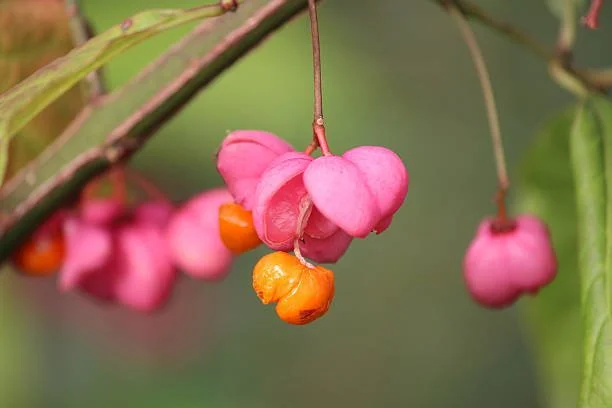
Elder Sambucus nigra goes through a lovely range of pink to deep red this time of year. And for a double whammy of colour and berries, a personal favourite of mine, the spindleberry Euonymus europaeus really does come into its own in autumn.
There are a few wild herbaceous perennials that could add some subtle colour into the garden now, amongst them bracken Pteridium aquilinum that goes through yellow and deep orange, hairy willowherb Epilobium and even dock Rumex obtusifolius turns the most remarkable colours as it goes into dormancy.
Finally, and I would imagine controversially, Bramble is not an easy plant to contend with in the garden but we all love a blackberry and what an amazing range of autumn colour.
Understandably, gardening to include plants like these many of which are considered weeds does take a slightly different outlook but there is a wealth of riches in our wild flora that I find challenging and compelling and I've always got an excuse for not having done the weeding!
Whether we want these plants in our gardens or not, they’re a pleasure to look at in the countryside at the moment.
NB, remember that it’s illegal to dig up any wild plant and always make double sure that the plant is what you think it is if you’re going to eat it.

Sweet chestnuts, conkers, oaks and beech trees
October 2022
At this time of year, as I stand and gaze upon the woodland in front of you, it appears as if decorated in a multitude of bright green baubles. What with this and the nostalgia of roasting chestnuts over fire at Christmas time, I think that the sweet chestnut Castenea sativa trees may signal, I hesitate to say, for fear of getting lynched, the run up to Christmas, or at least the entry into autumn.
It is commonly thought that they were introduced to Britain by the Romans in circa AD 100, to provide a supply of chestnut flour or coarse meal for the legionnaires. The nuts being as high in starch as wheat and twice as high as the potato, it is also the only nut to be a good source of vitamin C. The sweet chestnut, though non-native to Britain, has become a naturalised species and is generally welcomed in the landscape as it behaves much like a native tree as opposed to an invasive species.
Sweet chestnut trees propagate mainly by seed, which are their nuts, a nut merely being a seed with a hard shell. All nuts are seeds, but not all seeds are nuts!
Each bright green and very spiky husk contains two or three nuts which start to fall from late September, though the nuts at this time will not be mature. The best nuts will be those that hang on only to be brought down by frost.
The sweet chestnut is not to be confused with another species, the horse chestnut (conker tree) Aesculus hippocastanum, which was introduced to Britain as late as 1616 and is from a completely different family more closely related to the lychee, but horse chestnuts are not considered edible. The conker was not always their most famous attribute. They were introduced, for their size and stature but mainly for their impressive flowers and have been used widely as avenue trees, a well renowned one being the mile long chestnut avenue at Bushy Park north of Hampton Court, which was designed by Sir Christopher Wren in 1699. People still meet every year on Chestnut Day (the nearest Sunday to 11th May) to celebrate them. You may notice that our horse chestnuts don’t look very well these days, with brown blotches on their leaves, this is due to a leaf mining moth whose caterpillars mine inside the leaves, this was first identified in Wimbledon in 2002 and spread across the country at a rate of 30km a year. Another lesser issue they have is leaf blotch fungus, neither of these are fatal but will reduce photosynthesis and so possibly weaken the trees own resources.
Interestingly, sweet chestnut is a cousin of both the beech tree Fagus sylvatica and the oak tree Quercus robar. Each of which have nuts of their own.
Looking at the nuts on the beech trees, I wonder if we might be having a beechmast year this year, where once every 5 years or so all of the beech trees drop a heavy crop of seed. The seeds being a desirable food source to animals such as mice and squirrels and young saplings being very attractive to deer, this is done so that through sheer number, some seeds and saplings may grow to maturity. If you can gather enough of these nuts and have the equipment to press them, then it is said that they make a very fine cooking oil.
Beech is recorded as a native tree to Britain, though I’m not sure how the people in the know about these things have slipped this through as it’s only a comparatively recent one, the pollen record showing it to have been present for approximately 3000 years.
The subject of whether a plant is native or non native is a tricky one but as a starting place the BSBI (Botanical Society of Britain and Ireland) would describe a native plant by definition as ‘either a plant that arrived naturally in Britain and Ireland since the end of the last glaciation (i.e. without the assistance of humans) or one that was already present (i.e. it persisted during the last Ice Age)’. The end of the last ice age was approximately 11,700 years ago.
Oaks also have mast years as acorns are of course nuts too and though technically edible are very bitter and high in tannin that requires leaching in order to make palatable. Perhaps the most well known use for acorns, apart from animal fodder, is coffee, something promoted during the war when supply chains for real coffee were limited, but once processed acorns can be roasted or ground into flour for a multitude of uses. I recently saw a recipe for acorn brittle that I’m interested to try!
NB, remember that it’s illegal to dig up any wild plant and always make double sure that the plant is what you think it is if you’re going to eat it.
Photo by Hugo Le Cam on Unsplash

Ground elder, buttercup and marsh thistle
June 2022
What did the Romans ever do for us I hear you ask! Roads, sanitation, underfloor heating, yes, yes, but no one ever mentions ground elder Aegopodium podagraria, they kept that one quiet!
The Romans brought and cultivated ground elder as a pot herb for culinary and medical purposes, being used mainly for gout (one of its common names being goutwort) and to eat as a vegetable. The use of ground elder carried on through the ages with the Anglo-Saxons using it to clarify beer, so not all bad then. The plant, seemingly bent on liberation, soon escaped its confinement and, as shown some time later in the 1962 Atlas of the British Flora, is recorded as covering pretty much every part of the British Isles.
Ground elder, which spreads by creeping roots (rhizomes) and also by seed, can be found mainly (as the Biological Records Center tells us) in a wide variety of disturbed habitats, especially hedgerows, road verges, churchyards and also neglected gardens, no offense taken!
As you might have noticed by now, I’ve decided to talk about some plants that we could easily see in our garden (which some of us will be happier about than others) as well as when we’re out and about.
Next up, and looking amazing at the moment in my garden if I do say so myself (though I’m not sure that it’s anything to be proud of), is the creeping buttercup Ranunculus repens. I’ve fully embraced this native plant's creeping habit which it manages by sending out stolons, overground runners that then root at points along its length as strawberries do.
The name Ranunculus comes from the latin rana meaning frog, while culus indicates the diminutive form, so ‘little frog’. Saying goes that it’s named that because the buttercup is often found in damp places, as are frogs, but that takes a bit of a leap of the imagination. Maybe Carl Linnaeus, the 18th century Swedish botanist/zoologist who basically invented taxonomy was having an off day. Repens by the way, refers to the plant's habit of creeping.
The creeping buttercup is one of only a couple of buttercup species to host Hydrothassa glabra, a sweet little beetle 3 or 4mm in size and coloured dark metallic blue and orange.
Lastly the marsh thistle Cirsium palustre. Apparently the word thistle comes from the Old English thist-ley meaning ‘to prick’ and as the name of this species would suggest, this thistle grows mostly on damp ground and reaches approximately 1.5m tall. It’s a biennial so flowers in the second year then dies. The main reason that I wanted to talk about this thistle, besides it growing in my garden as yet another experiment, is that it is a super pollinator attracting bees, flies, moths, butterflies and beetles. It was rated to have the most nectar production (nectar per unit cover per year) by a project supported by the UK Insect Pollinators Initiative. Also in the top five were the grey willow Salix cinerea, common knapweed Centaurea nigra, ball heather Erica cinerea and common comfrey Symphytum officinale. What’s more, the marsh thistle can be used to eat. I’ve not tried this but I read that you can strip the plant down to its stem, peel this and then dip it in sugar a little like rhubarb…No no, after you! You might have to speak to Nicky, our local forager about this.
NB, remember that it’s illegal to dig up any wild plant and always make double sure that the plant is what you think it is if you’re going to eat it.

Bluebell, Wood sorrel and muskroot
May 2022
If, as the song goes, you go down to the woods today, you’re sure of a big surprise…well if that surprise is that you fall over, then you may be lucky enough to end up at eye level with some of the plants that I’ve been checking out this month.
All of these plants can be found without too much difficulty in either (and almost certainly both) the woods at the end of Pottle street and up towards Heavens Gate.
The first to catch my eye were the delicate lilac veined, five petaled flowers of wood sorrel Oxalis acetosella. This plant, flowering around Easter time, is known in much of Europe as ‘alleluia’. It has almost clover-like three lobed leaves that apparently act like a weathervane, folding up before and during rain and when it gets dark. Well, one of those might be useful, I guess the others you could work out for yourself. The leaves have a lemony flavour but should be consumed in moderation. Wood sorrel was in the past used for treating scurvy due to its high vitamin C content.
You’ll need to stay very close to the woodland floor to see the tiny flower of ivy-leaved speedwell Veronica hederifolia. This plant is an archaeophyte apparently (a new word for me) meaning it’s non native but introduced in ‘ancient’ times, so some time before the 15th century (pre early modern period). The name describes the leaves Ivy Hedera and leaf folia.
If you still can’t get up, you’re in luck because you’ll be face to face, as it were, with muskroot Adoxa moscahatellina, also known as moschatel or Good Friday plant (as it nearly always comes into flower by the beginning of April) This plant’s not showy but really subtly beautiful when you look closely. I guess when it was given its genus name they had this in mind as Adoxa means ‘without glory’. The other (specific) part of its name moschatellina means musk, referring to the musky smell it can emit when damp. Another of its common names is Town hall clock, so called because of the flowers that sit at the top of the stalk, four forming the (clock) faces of a cube and the fifth above.
Having eventually got to our feet and not needing to be quite so close to the floor we can enjoy the wood anemone Anemone nemorosa. The sight of this lovely, early spring, white flower always makes me happy. It is a good indicator of ancient woodlands or hedges as its seed is rarely fertile and therefore relies on its root system to spread, which it does at a pace of approximately six feet each hundred years.
Last but by no means least! I can’t not mention the bluebell Hyacinthoides non-scripta which is looking great, and not to be mistaken for the invasive, non-native Spanish bluebell Hyacinthoides hispanica, the former being smaller and a more intensely coloured deep blue/purple; is stronger scented and all the flowers grow on one side of the distinctly drooping stem. If you want some bluebells in your garden these are the ones to buy or gather seed from.
Have fun in the woods and please watch your step!
NB, remember that it’s illegal to dig up any wild plant and always make double sure that the plant is what you think it is if you’re going to eat it.
Primroses, ramsons and nettles
April 2022
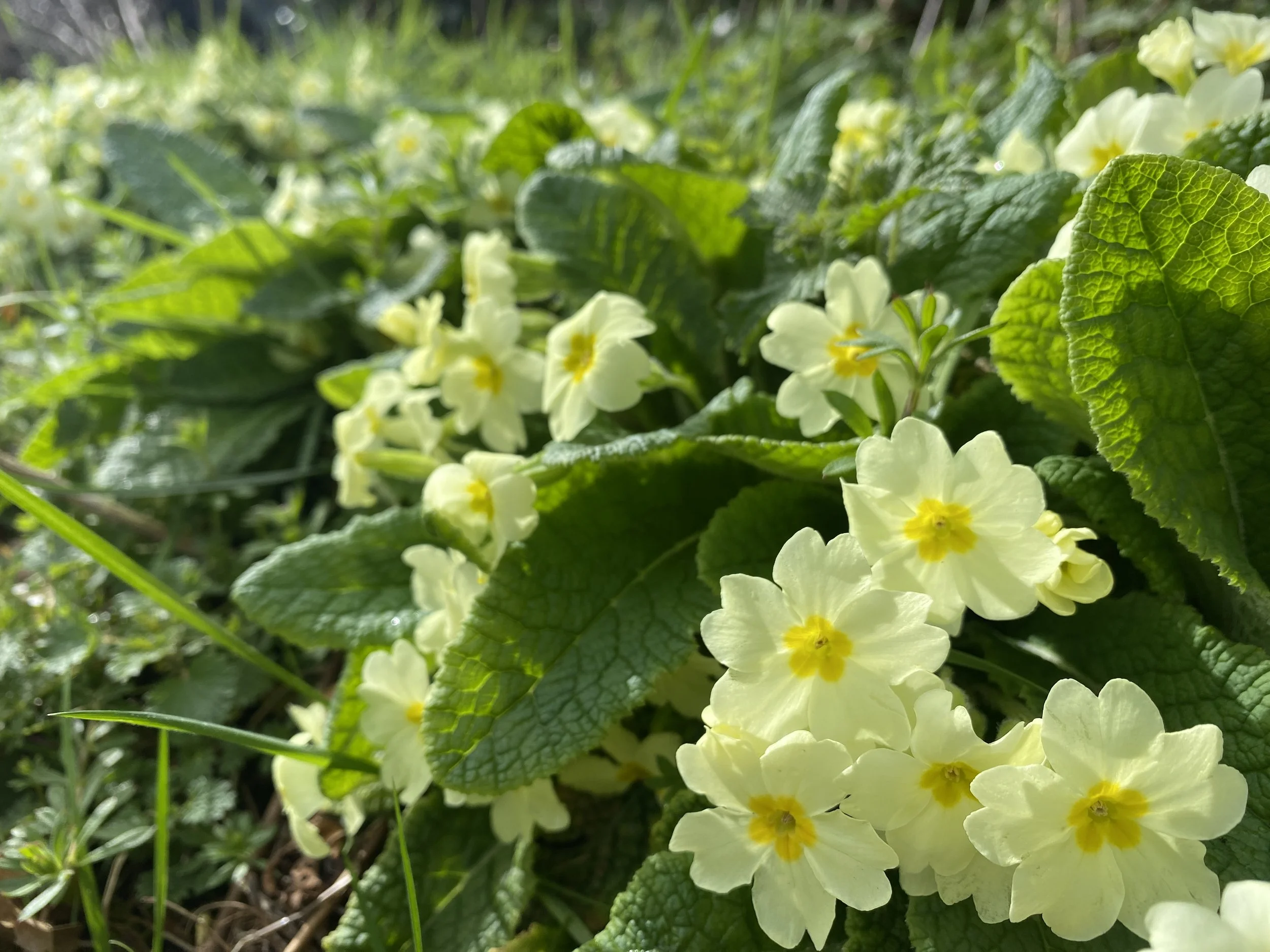
On my dog strolls, I’ve been interested to see what wild plants are emerging. Especially as spring finds its feet, not before time as far as I’m concerned! It has to be the primrose Primula vulgaris that are front and centre through March and continue strong into April. Unsurprisingly I guess with the name prima rosa, or first flower of the year (although that’s not strictly true as the beautiful snowdrops on February’s cover show). But I can’t let those little yellow faces go unmentioned, not least because it’s Primrose Day on the 19th April, or so Richard Maybe tells us in ‘Flora Botanica’ with the botanist Sir George Birdwood apparently suggesting this after Benjamin Disraeli’s death in 1881 as the former Prime Minister had such an admiration of the flower.
I wonder if I’ve spotted a couple of the similar plant oxlips Primula elatior, which would be exciting as they are a vulnerable, near-threatened species usually confined to the area where Suffolk, Essex and Cambridgeshire meet, but I’m not entirely convinced that these are not an ornamental escapee from a garden, perhaps a local botanist can put me straight on this?
The ramsons or wild garlic Allium ursinum are getting well into leaf in the woods in the north of the village above Newbury and there's a little to be found on the road to Maiden Bradley. We like to make a pesto out of the wild garlic, freezing this in an ice cube tray is a great way to get a portion that you can easily throw into pasta or mix into a dressing for a salad, but this year I’m going to make some green garlic butter by simply beating the cleaned and shredded leaves into butter for a fresh subtle alternative to traditional garlic butter.
I’ve had a couple of passes over the nettles Urtica dioica in the garden already, picking the tips, blanching and freezing for later use in anything that we would use spinach in, I’m pretty fond of a smoothie made with any berries, fresh or frozen, a handful of greens, usually spinach but nettles in this case, milk and water then blend. I’ve also used the cooking water as a hair tonic so if you see me around the village with green hair don’t be alarmed!
According to the Natural History Museum our stinging little friends have been reported to have over 100 different insect species feeding on them alone and they are host to the red admiral Vanessa atalanta (I think I may have gone to school with her) small tortoiseshell Aglais urticae and peacock Aglais io butterflies as well as moths such as the Burnished Brass Diachrysia chrysitis, the angle shades Phlogophora meticulosa and the ruby tiger Phragmatobia fuliginosa to name just a few of the more charismatic species. And to name a few of the less charismatic species; the brilliantly named golden-bloomed grey longhorn beetle Agapanthia villosoviridescens, and Parethelcus pollinarius no funny common name I’m afraid but this little guy’s only source of food is the roots of stinging nettles, look him up, I mean if a weevil can be cute…Old longhorn’s a good looking chap too.
Talking about early flowering wild plants, another that flowered alongside the early primroses but who’s flower has now gone over is the winter heliotrope Petasites fragrans, this has a great scent and maybe presents a food supply for early pollinators, though this is an extremely invasive non-native species. Being new to the village I’m not sure about the pace of its spread where I see it on the bank along from the island, but I’m surprised, on my travels slightly further afield how quickly this is populating ground.
Just to see everything bursting into life at the moment is very exciting and I look forward to more walks and observations, maybe with a bit more sun, over the next month.
NB, remember that it’s illegal to dig up any wild plant and always make double sure that the plant is what you think it is if you’re going to eat it.

Ficaria verna - Lesser celandine
To look at lesser celandine, you’d have thought that this cheerful little flower said to be the ‘spring messenger’ as one of its common names suggests, would be uncomplicated and its message simple.
Nothing could be further from the truth. For Ficaria verna, one of approximately 700 plants in the Ranunculus family, being renamed in 2010 and formerly known as Ranunculus ficaria L. It seems, is just the start of the confusion that seems to surround this plant.
For a start there are two very similar plants, Ficaria verna ssp fertilis, the ’true’ lesser celandine formerly named Ranunculus ficaria ssp ficaria and Ficaria verna ssp verna formerly known as Ranunculus ficaria ssp bulbilifer, a subspecies of lesser celandine that has bulbils that break off and arguably spreads wider than the bulbil less form, these little tubers are where the plant gets its other common name pilewort from. It is thought that the bulbil subspecies is under-recorded because the bulbils are not straightforward to spot. Simple right?
On top of that celandine comes from the Greek word chelidon which refers to the bird swallow. There is some dispute as to whether this name refers to lesser celandine as it has usually been in flower for a while before the return of the swallows. It could be that lesser celandine is a sign of spring as is the swallow, but also that lesser celandine was confused with greater celandine Chelidonium majus whose other common name is swallow wort.
Lesser celandine Ficaria verna, found in woods, on hedge banks, in meadows and on roadsides, likes damp soil that’s not too acidic. The flower has a charming habit of closing its petals before rainfall, so in folklore it is said to predict the weather.
Ficaria verna is host to the leaf mining larvae of two flies that can only feed on a few plants from the ranunculus family and two beetles including the jewel beetle Anthaxia nitidula.
Is a host plant also to one of the rarest of Britain’s butterflies, the heath fritillary Melitaea athalia and six moths including the charismatic Yellow shell Camptogramma bilineata.

Galanthus nivalis - Snowdrop
Yep, I know, I know, this isn’t a native…or is it? In Flora Botanica, Richard Maybe alludes to a doubt about this saying ‘Yet this history of deliberate introduction and cultivation [In church yards and gardens] does not mean that snowdrops are not authentic wild natives in some parts of the west and south. And even where their origins are doubtful, they always have a wild cast about them.’
The snowdrop is a perennial bulb that grows on moist woodland and in other shaded places, spreading mostly by division; it is often found in gardens, parks, churchyards and on road verges; it was known to be in cultivation in Britain in 1597 but was not recorded in the wild until 1778.
So I’m curious to see what benefits these ‘February fairmaids’ used to celebrate the Feast of Candlemas on the 2nd of February, have in the ecology as, if not native, they are widely naturalized. Here in my wiltshire garden in mid February, it’s pretty much the only thing out apart from a few primroses. In the wider countryside the gorse Ulex europaeus is flowering bright and yellow as it almost always seems to do, does it ever stop flowering?
It seems to be difficult to find much information on where the snowdrop fits into our ecology and as this is such a showy plant, if native, it’s surprising that earlier written records of it growing in the UK haven’t been found.
It does have the interesting ability to open its petals upwards and outwards when temperatures reach 10°C and above and pollinating insects are likely to be flying.
Even if not previously native, It’s a plant that we seem to accept as our own, as a welcome introduction. With a native colony as close as Brittany and being widespread on the continent this could well be a plant that can help us to confront the challenges of climate change and an upwards move of wildflowers and their animal associates as temperatures rise.

Primula vulgaris - Primrose
Primula vulgaris is the first plant to flower in my garden this year which is not surprising as it’s all in the (common) name, primrose - prima rosa, or first (native) flower.
This starts this series where I aim to post every native plant in my 1/4 acre Wilshire garden. Last year I counted 77 so buckle up!
Primula vulgaris is an herbaceous perennial plant and is found typically in woodland, hedgerows and on North banks but also in grassland though they’re not super keen on hot sun, so no danger of that in the UK at the moment.
The primrose is recorded as hosting 31 British insects including two Diptera (flies) for which Primula is the only host and 29 Lepidoptera (butterflies and moths) most of which are moths and a couple are butterflies including the beautiful Pearl-bordered fritillary (Boloria euphrosyne) and fascinatingly the Duke of Burgundy (Hamearis lucina) whose larvae’s only food plant is the Primula the primrose and cowslip species.
Richard Maybe tells us in ‘Flora Botanica’ that we have Primrose Day on the 19th April which is a little way off but demonstrates just how long these little rays of sunshine stay in flower and all the early nectar they will supply to our hungry insect pollinators. Primrose day came about with the botanist Sir George Birdwood apparently suggesting this after Benjamin Disraeli’s death in 1881 as the former Prime Minister had such an admiration of the flower.